Sunday, April 1, 2012

Thank you Ghana for an interesting adventure

Having just got back to Perth, I look back on a visit that I will defiantly not forget hurry. It has been one that has been fodder for many memories.  This trip has been an unexpected 5 weeks but in many ways it has been exactly what I wanted. 

To begin with Ikando, the NGO who I organised the trip through, soon became the "I can't do" of African volunteering. It  gave me a valuable insight into NGO politics and international volunteerism. Who actually benefits when I pay to go and volunteer in another country? is it worth it? and where does the capacity building occur?


I still haven't worked out the answers!


If you haven't heard the story, when I arrived the boss said he was expecting a Sarah who was a lawyer and  he'd never heard of this Ikando Foundation/"I can't do".  When I showed him what I thought I'd be doing he said he'd never seen it before and that he have never advertised such  a position.  In short, ikando.org advertises volunteer positions that do not exist.


While I got off to a rocky start, a lot was learnt.  

Despite the mix up, I was able to see how the Red Cross works in a country that isn't not well off.  They play an equally grass roots role as in Australia but instead of teaching First Aid (probably run for profit), facilitating blood donation and  providing accommodation for Children with disabilities, Ghana Red Cross Society runs healthy living classes for kids and teaches very basic first aid for learner drivers as well as mothers' clubs. Much of it is the same but it is different in so many ways.  So during the 5 week stay, I was able to observe and participate in a few of these activities.  


Mothers' Club


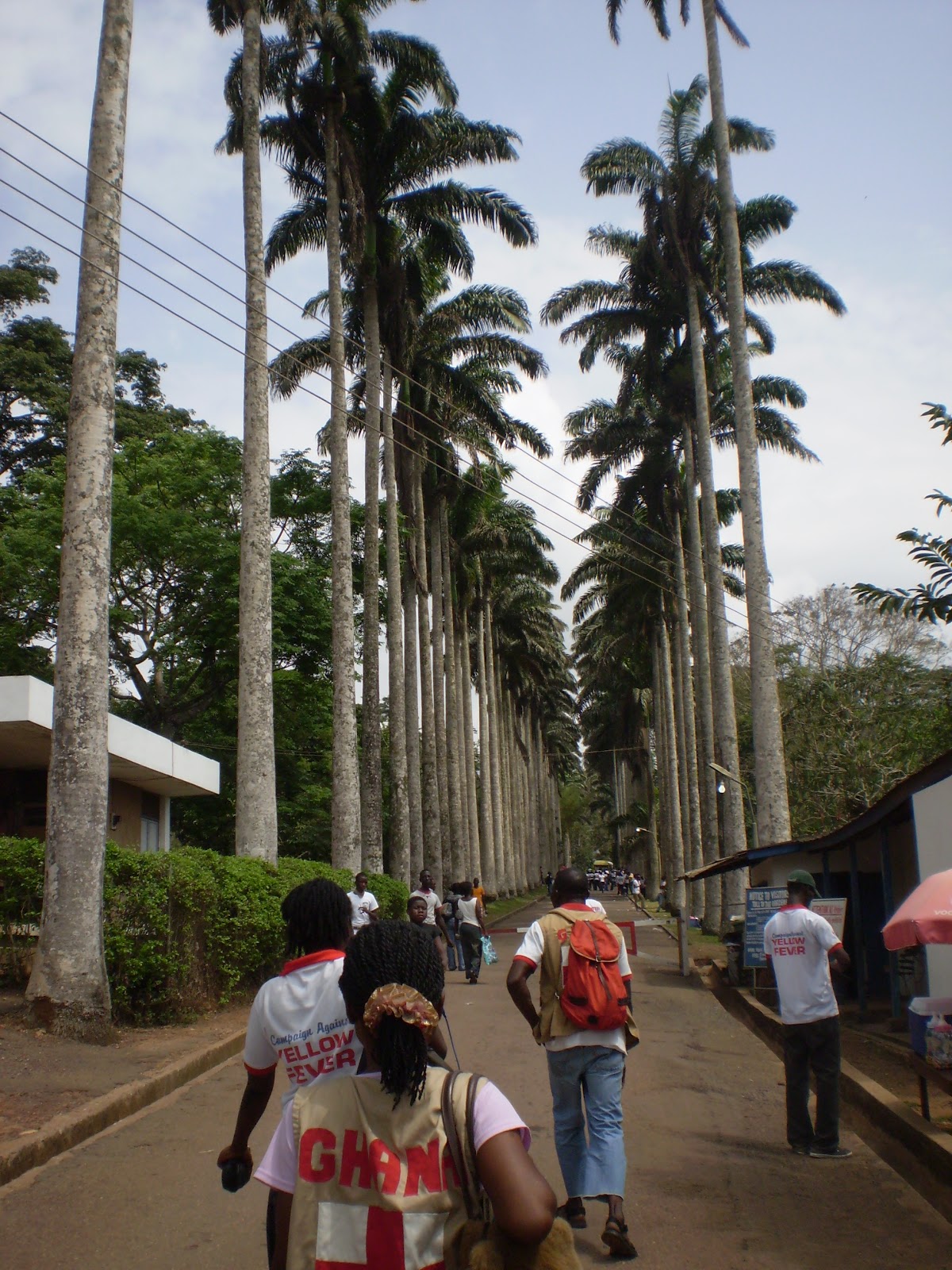
The more memorable ones were the National Youth Day where 2500 kids came together in a Botanical Garden for presentations, dancing and lots of food. I really enjoyed handing out the drinks and snacks while meeting so many kids. Seeing more of Ghana outside Accra  was another bonus!!!

Apart from Red Cross activities, there was the many strange and interesting things that will stick in my mind.


Travelling in Tro-tros would have to be one of the more memorable activities in Ghana. Not only are they completely different to any form of public transport in metropolitan Western Australia (plus being totally cheap) they often provide you with a wealth of unusal memories.


Fresh meat anyone?

Undies?


Another experience that I'll never forget is walking through what they discribed as "The Slums". While I'd seen environments like that before on TV, I'd never been to one. While I could go on about how poor it is and how hard life is for them but in reality the locals just get on with it and make the best of what life has given them with as much dignity as possible. It was just sad that it has to be like that.  


Finally, the kindness of strangers is something that I'll always remember and to them I say a big thank you. Accra can be a scarey experience for a small white girl and these strangers  had no idea how nice it was for them to show me where to go and to make sure I was ok.
This trip to Ghana was an experience that I'll never forget. While it didn't go as first planned and I couldn't contribute as much as I had hope to, I learnt so much about life there and met so many cool people. Travelling to Ghana has made me want to see more of the world especially in a volunteer capacity.     


Saturday, March 24, 2012

Another Ghanaian adventure at Boti Falls

Today was time to enjoy my last weekend in Ghana and I thought it was a good time to visit Boti Falls which is a few hours from Accra by tro tro. Luckily, I had a friend to help to navigate the unfamiliar transport system.

Riding in a Tro Tro
It was really nice to see more of Ghana than just the capital city and going up to the hills behind Accra brought some welcome relief to from the intense heat. After four hours and the usual drama of travelling in Ghana we finally got there. 
We paid our money and off we went on what we thought was a leisurely walk but how wrong we were!! 
The walk soon turned in to a serious jungle climb over these rocks and up some steep slopes. Being not in to sport or serious physical exertion of any kind, I was not impressed - especially before lunch. but luckily, something possessed me to buy a Snickers Bar before I left town so all was well and a hypo meltdown was avoided.


While we enjoyed our Snickers we were able to see an amazing rock that was perched on another as well as the awesome view from our horrendous climb.


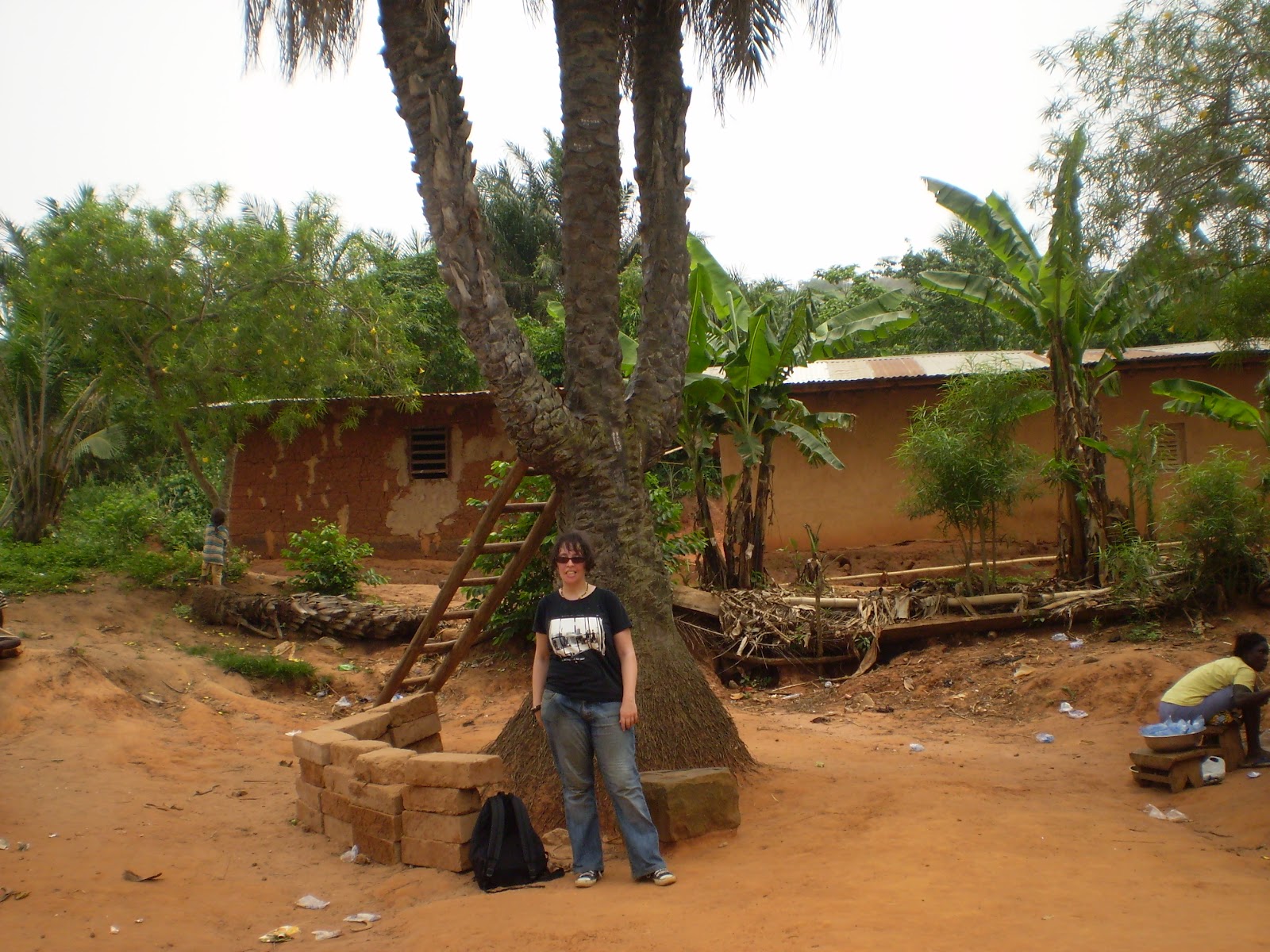
No far from this rock was we got to see a rather unusual tree - one trunk but with three heads so to speak.


As I was climbing down, I was dreaming that if I had a few million dollars I would turn the place into some massive Eco Tourism and sustainability education venue where kids could learn to appreciate the natural environment and the importance to taking care of it. As a tourism attraction it is very under developed but I guess that tourism is not one of one of Ghana's priorities right now.  


Boti Falls


After a long climb down we finally got to the falls, which was amazing!!! Unfortunately it wasn't the rainy season so there was not much water but it was still very beautiful. While we were there, a group of excitable children became so fascinated by the two Obruni (white people) that they just gathered round to watch them swim, which would have put me right off but it didn't seem to bother them.


Visiting Boti Falls was well worth effort and would recommend it to anyone. Apparently you can stay the night as well as visit some other water falls near by but don't let the distance from Accra stop you from going as the experience is well worth it. 


Thursday, March 22, 2012

An Obruni's impressions of Ghana

Oburni is the term that Ghanaians use for white females and it is something that us white girls get quite used to hearing. I have been here for almost four weeks and have observed many things about the country where I have been volunteering. 

Firstly, their commitment to education is impressive. Obviously, like so many in developing countries, Ghanaians see it as a way to achieve social mobility and a tool to escape poverty. I just hope that the standard of education is good enough to ensure that they are able to use it to provide for themselves and their families as well as the wider community. I also hope that the government is able to facilitate economic growth so that there will be a demand for all those new graduates.   

Secondly, I noticed a collective sense of lethargy in Ghana. You cannot walk far without seeing a person sleeping on the pavement/bench or slouched over a table with their head in their hands. Maybe it's the heat, maybe it's the malnutrition. It seems in conflict with their drive to become better educated and to move out of poverty.  

A couple of evenings ago at the Ikando House (where I am staying) my room mate and I were both chatting about the state of things in Accra and we both had noticed a simmering tension that seemed to be blubbering under the surface. Despite Ghana's obvious commitment to Christianity and Islam, people seem to get angry and tempers seem to blow over really quickly. I don't know, but such displays of anger seems to be in contraction with the Christianity that I grew up with. One idea that we had that all it would take would be a suicide bomb to cause ciaos but I'm thinking more of a struggle as a result of water, food and employment insecurities, but we shall see.....          

Also, mobile technology is so far more advanced from Australia and in many ways it is to make up from the lower levels of computer ownership. In Ghana you can send credit to one another, access your bank account, etc etc and all from a non-blackberry/iphone type of phone.
  
Finally, so many Ghanaians that I've spoken to have relatives overseas in America, Europe as well as Australia and so many of them are so desperate to join them. I don't blame them really as life here is tough and being exposed to media that makes the west look very appealing. But in reality, adjusting to a culture that is so different and establishing yourself in a new culture makes moving to the developed world not that easy and not all that it is cracked up to be.      

Sunday, March 18, 2012

A noisy finish to a slow working week

It was a noisy Friday night last night when two local Nima churches decided to broadcast their services via load speaker while the local mosques' were calling followers to their Friday night prayers.  It was a cacophony of styles and values but this didn't stop the members of the Ikando house from adding Reggae to the musical landscape and enjoying a beer while watching the sunset.

This week continued to be frustratingly slow due to my boss being away on Thursday/Friday so I was at a loose end. But I did eat a bit of local food and do a spot of shopping as well as make progress with my "holiday reading".


I did become a typing queen on Tuesday and helped Management to type pages and pages of text and on Wednesday I help to register people for their mandatory First Aid Course as part of the drivers' education.   

Yesterday was spent providing hand washing services for a wedding reception. It was nice to see a local wedding which wasn' t too wildly different to the ones in Australia. Lots of food was eaten by the guests and the kids seem to have a great time.

Today, eating and reading are on the cards which are a great way to spend a gray and overcast Sunday.   

Tuesday, March 13, 2012

Ghanaian weekend adventures

This weekend was thankfully very busy and quite intense  - how I like them really.

Saturday was spent at the Red Cross National Youth Day at a Botanical Garden outside of Accra.Getting there, in true Ghanaian  style, took  ages with lots of waiting in a long line for Tro Tros in a dusty paddock.When we finally got there we found hundreds of kids running around enjoying the outdoors and taking part in Red Cross activities. My job was to help handing out the juice which was totally fun.  


Although, one big difference between Ghana and Australia is that here they have no problems in leaving litter. Partly because there are hardly any bins but... I don't know. My bag becomes full of my own rubbish that I just can't bring myself to let drop.   


Getting back involved taking a shared taxi with four strangers to an unknown location. The driver thought it would be funny to drive at about 100 KPH into on coming traffic, but we made it out alive.

With the blessing of my Boss, I got to go to Cape Coast for two days. Cape Coast is famous for its connection with the slave trade. It was a strange experience walking through the "door of no return" and also the church directly above the male slave cell - seriously, how could they?   

But looking out over the beach that is below this Door of No Return, it was nice seeing people enjoying the beach and local boys having a casual game of football. Which, considering, their passion for football, they took very seriously. It was nice to hear that in 2008, either some the descendants of people that were taken as slaves or their remains were taken back through the door as a symbolic gesture. Breaking the chain so to speak.


The rest of the day want spent walking around and hanging out, although the constant interest by the local men began to get a little annoying. They are often so insistent to "take me as a friend" or to get my number.

waiting
This morning began by waiting for the bus what didn't seemed to be coming but suddenly a Tro Tro appeared out of no where with a kid hanging out of the door shouting "Accra, Accra". Awesome, I thought as I managed to score a seat. 


After finally getting home, I enjoyed a coffee and started doing the washing - by hand. 

It is now the half way point of my Ghanaian adventure, I starting to get into a routine such as to doing the laundry by hand and not using the water out of the tap. Finding the right tro tro to work from Nima Markets has long stopped being a challenge!!           


Nima Markets

It is sad to think that there is only two and half weeks left before the long journey home but I am sure it will be an awesome couple of weeks.    


Friday, March 9, 2012

Football fever, mothers' clubs and Ghanaian food

I was privileged to spend my first weekend in Ghana at a Vodafone Corporate Challenge where many Ghanaian companies played against each other while the Red Cross provided the first aid. It was amazing to see their passion for football and their skill even if they were just doing it for for fun. It was a hot as well as dusty two days but it was filled with music and football and a great way to spend the weekend.
      

The Band


One of the highlights ways finally trying local food. While it wasn't visually very pleasing, it soon became apparent that looks can be deceiving - this carb filled dish with rice, bananas, beans and pepper was amazing and kept me going all day. 

I look forward to trying more of the local food over the next few weeks. 


On Monday I got to attend Mothers’ Club meeting which was a great opportunity to see the grassroots work of the Red Cross in local communities. These Mothers’ Club  empower women to provide First Aid to the communities in which they live. They also play a vital role in Disaster Preparedness as they educate local people on how to prepare for disasters including pandemics. Mothers’ Clubs also provide assistance during times of emergency in that they are the “eyes and ears” on the ground and can provide valuable information on the number of individuals effected by the disaster as well as what assistance is required. While  the meeting was conducted in the local language, it was an experience that I really enjoyed. 


Tuesday was Ghana's Independence day and it was a great opportunity to spend it at the day at the beach. After a bit of drama getting there and having to paying 5 cedes (yes, here you have to pay  - a bit of a shock for an aussie) for access to the beach, I settle down with a local beer and enjoyed some reggae, plus some of the local personalities.   


Wednesday was spent at the office waiting.....


Today, I got to go on an errand with a co-worker which was a good way of seeing more of the Accra. We had to hand deliver a letter which is the way of delivering important documents and it when we got there we realized that it needed some editing and so we had to go back to the office. Later I got to see the central markets in Accra which was intense because of the number of people and new sights and smells.


They really wanted me to take a photo of the head of this beast


Tomorrow, they have told me to "rest" even though I soooo wanted to do some work (I can rest when I am dead, seriously) but what can you do? I'll probably go to National Museum and try and see more of Accra. The Red Cross National Youth Day is on Saturday and I'm off to Cape Coast on Sunday. Awesome!!!


Friday, March 2, 2012

Not so much a fish out of water anymore


It didn't take long to settle in and to find my feet in Ghana, even if it was after the help of Quashie, the volunteer support person.  

This week has all the hall marks of a true volunteer project in a developing world. When I first  arrived at the regional office of the Red Cross, they had no idea of who I was or why I was there and what I thought I was going to be doing went out the window. 

As time went on,  I found that there were no schedules and when I thought things where going to happen, they didn't. Plans often changed with no warning.


In many ways this isn't an unusual experience in the world of volunteering and it is very common when working in developing countries for there to be differences in expectations  and differences of pace. It has been a slow process to try and find something useful to do that is beneficial for everyone. But it is been a little frustrating trying to get anything going, to get answers to question on when will things happen, etc, etc but that's how they do things here. The culture a lot more vague here and things happen in their own good time  but it's a learning process and that's why I am here. Hopefully next week should be better. 

Last Tuesday I spent a really interesting day with one of the Red Cross people. Much of the day was spent  at the car and driver licencing place where the Red Cross runs mandatory First Aid classes as part of their Drivers' Education.

While I was waiting for classes to begin I was told that "the boss wanted to see meet". Oh dear, I thought!!!    

I was ushered into this room where I was met by two middle-aged gentlemen who proceeded to interrogate me on why I wasn't married and seemed really keen on setting me up with a local. I had to explain to them that in no uncertain terms that I didn't want to get married but if I changed my mind I would know where to go.

In the afternoon, I sat in on a health class in a primary school, which involved going over the basic concepts of  healthy living, such as drinking clean water, washing hands before touching food etc. The kids seemed to love learning about how to stay healthy.    

Today, I finally got to do something. I worked with them in setting up a blog so that they could promote their programmes and keep people informed. Since 70% of the Red Cross members are young people, it makes sense that they is something on the web.  It was one of my ideas that seemed to get their attention and maybe because blogs are free and are easy to use and, like their website, it doesn't have to be run out of head office.   

It has been fun taking the "Tro Tros" everywhere. Tro Tros are old minibuses that go around he city and are usually packed with people. I try and get one from Tema Station which is this large area packed with Tro Tros as well as market stalls and finding one to go to Nima (where I am staying) involves going around and finding it as there are no specific location where they pick people up from. 


Anyway, I wonder what the weekend will bring and what exciting things will happen. 

Sunday, February 26, 2012

Is culture shock the down side of travelling?

After a 27 hour journey that included a 13 hour stop over in Jo'burg, I have finally arrived in Ghana. 

The first day was admittedly quite a shock to the system. While I knew in my head that Accra would be completely different to the sleepy town that I currently live in, I felt completely out of of my comfort zone and out of my depth. I had also forgotten about the what it is like to travel on your own and in particular, what it is like to be in a place where you know no one.   

While these feelings were very real, I was very annoyed with myself that because I had worked so hard to save up enough so that I'd could spend my annual leave doing something useful and learning something about a country that was far away. 

So, what's so bad about culture shock? why do I keep on putting myself in these situations when it was so confronting and uncomfortable?

Someone once said that the only time you grow a s a person is when you are outside of your comfort zone and you are surrounded by everything that is unfamiliar. 

Maybe this is why I choose to spend my holidays from work in a country that is so different to my own, so I may appreciate everything that is good about my life, learn from those who live differently to me and gain perspective on the world that I live in. 

So maybe culture shock is not the down side of travelling but an important part of a really rewarding process. 

I keep on telling myself that I will soon find my feet and that the feelings of culture shock will soon subside and, like previous trips aboard, will have an experience that I'll never forget for the rest of my life.               

Wednesday, February 22, 2012

While Perth scorches in summer heat, Arts Festival turns city red hot

Summer in Perth is always hot but when the Perth International Arts Festival (PIAF) commences in February Perth suddenly becomes even hotter. For several weeks in summer Perth becomes a vibrant and animated city with a strong arts and music scene. PIAF makes Perth feel like a real city rather than a large provincial town.


2012 marked PIAF’s 60th birthday and it showed no sign of slowing down. In my humble opinion, this year’s programme proved to be one of its finest and most diverse, with an outdoor contemporary music venue in the city, outdoor films, opera, visual art, theatre, classical music as well as much more


PIAF 2012 opened with an amazing performance by French circus trope Le Studios de Cirque with a performance called Place des Anges. This mind blowing performance involved acrobats gliding from one office block to another in a section of one of the CBD’s main streets while showering us with tons and tons of feathers.


The effect was mind blowing and the only way to describe it was - movingly beautiful. Young and old, people were captivated by the surreal nature of the performance. People didn’t want to leave, preferring to linger and enjoy the moment. When they did leave, they left with smiles of their faces and a sense of peace and wonder.


One of the changes to the 2012 Festival was the creation of the "Festival Gardens" which is home to PIAF’s contemporary music programme. This part of the Festival has defiantly moved on a long way since its Beck’s Verandah days. It just keeps on better and better and I can’t think of a better way to spend a barmy Perth evening. 'Little Roy’s Nirvana covers done reggae style was totally random and very cool.


Classical Music has often taken back seat in past festivals but this year there is a great line up with Tafelmusik, The Australian Chamber Orchestra (ACO) and a Chamber Music Weekend.  Mozart’s Magic Flute was staged at His Majesty’s Theatre and the WA Opera performed The Pearlfishers at the Supreme Court Gardens.

The ACO gave a energetic performance of Mendelssohn’s Octet tonight at the Concert Hall. Of course they are an orchestra made up of players with amazing technical ability but what makes them such a great ensemble and such a joy to watch is their passion, love of performing and commitment to the music. Polina Leschenko gave a lyrical and virtuosic performance of Chopin’s Piano Concerto. Her technique was superb and made Chopin’s demanding writing sound so effortless.


The Escher String Quartet had the huge task of presenting a Brahms Chamber Music Weekend at the State Theatre Centre. I got to go to the Sunday Afternoon concert and was blown away by their musicality and skill, not to mention Brahm’s great music. By the end of the Piano Quintet in F minor, the hardcore Brahms fans next to me had tears in their eyes, which show the power of music to uplift and speak deeply to people.   While a String Quartet is the epitome of collective music making, Pierre Lapointe’s performance in the String Quartet No.1 in C minor deserves a special mention. While I’m not a music critic, I appreciated his rich tone and delicate interpretation of the music.


The Perth Writers’ Festival is a must for any book lover and fan of big ideas. Unfortunately, I will miss this year’s festival, but the 2012 programme is bigger and better. A session with Annabel Crab is mandatory for any political hack and devotee of the ABC’s political reportage. While there is the usual celebration of the written word and hardcore debate of society’s biggest issues, there are also events for children such as circus workshops. Be prepared to spend all weekend there!
 
Each year the Perth Festival gets better and better, so thank you PIAF for bringing Perth alive every summer and for making it feel less isolated and provincial.

 PIAF 2013 – I can’t wait!

Thursday, January 26, 2012

External studies is no walk in park but not impossible if you love what you do

When I checked my email recently I found a note from Monash University informing me that my application to graduate had been approved.

While I already knew that I had passed my final units it was a relief to receive this as its one of the last steps in gaining a degree that was completed almost entirely online.


Completing a take home exam
The past few years have been an interesting progression through a master’s degree that often seemed like an all consuming project, especially considering that external studies is a little bit more challenging than the traditional method.


When you complete your degree via distance education (as they like to call it) your living room becomes the exam room, your bedroom becomes the lecture hall and your kitchen gets turned the “uni cafe”. 

This external studies option is not for everyone.
For one, you have to love what you do otherwise it is a lot more difficult to stay motivated.  With few opportunities to attend tutorials and lectures/seminars in person, you don’t have the same level of access to the information as an internal student would have. It’s not to say that internal students are spoon fed in anyway but they can attend tutorials and discuss the material in class and with tutors as well as students which makes it easier to understand the topics covered in the unit.

Monday, January 2, 2012

The use of force seems to be diplomacy’s oldest tool

Using force as a way to resolve dispute between countries has been common throughout history. The idea of the Use of Force was first conceptualised by St Augustine with the notion of “just war” and this provided a foundation on which Western thought has grown from.

This blog will look at the use of force in international law and how the principles of this discipline has changed from the ideas of the “Just War” to changes attitudes to the Cold War type situations and later to multilateral UN forces in failed states and internal conflicts.
 
Wars have always been part of history and there have been moments in time in which such conflicts have been the catalyst for change and the creation of new approaches to international law.

One of such moments preceded the 30 year war in the sixteenth century which saw the creation of the Peace of Westphalia which many years later became the corner stone of the United Nations.

This war was important as it gave birth to the modern country that we are familiar with today, especially in regards to Sovereignty. This concept of national sovereignty was born out of the right of a country to choose their own religion; but since the separation of church and state as well as a shift in values to a more Calvinist (more personal) engagement with faith, national sovereignty has become less about state-organised religion and more about governance and the provision of infrastructure.

While this does not directly relate to war or the use of force, it has played a substantial impact on the creation of the United Nations and the principles and ideologies that underpin their work.

It is worth briefly considering the nature of war as it could help shed light on why it has been so regulated (in order to encourage its use as tool of last resort) while at the same time being a common method to resolve international disputes. Kenneth Minogue describes war in an interesting way when he writes that ‘war, as Clausewitz puts it, is the continuation of policy – that is politics by another means. Rulers attack for advantage, and defend to protect the national interest. As in chess, one side or other must win, and even stalemates are merely a precarious equilibrium.  To lose this international game may be a desperate thing…. as many states discovered when overrun by Nazi Germany after 1939 (2003, p.238).

This idea illustrates why governments still revert to the use of force despite it being heavily controlled by the Security Council through chapter VII of the UN Charter.
Perhaps it is because of the limited availability and effectiveness of other diplomatic tools available to governments to protect and further their national interests and international security.

Another moment in history where war continued to influence international law was after the First and Second World Wars where war had a vast impact on the global political community.

International Law was established in an attempt to reduce the chances of full scale global conflicts ever occurring in the future. The laws and treaties that have descended from the UN have strongly impacted on the creation of treaties and codification of custom pertaining to the maintenance of international peace and security.

One important moment in the development in the international law’s perspective on the use of force was in the development of the International Committee of the Red Cross (ICRC) which soon became much more than a relief organisation.

The ICRC realised it needed to hold a ‘diplomatic conference to draft the terms of an international agreement that would provide for the protection and care of the wounded, and recognise as natural all those who attended and care for them’ (Stubbings, 1992, p.5). As time went on, the rttueureurtyyyyy the Committee of the Red Cross grew to be the catalyst for the creation of the Geneva Conventions.

What has become known as International Humanitarian Law regulates the use of force during times of conflict and provides a set of rules that not only protect civilians but provides a protocol regarding armed conflicts and the use of force.

In more recent times and especially after September 11, there was much debate in regards to how should IHL be applied to those who commit acts of terror and the “War on Terror” that followed. The debate seemed to centre on the question that should the terrorists, who clearly have violated IHL, should be treated under IHL and the Geneva Conventions.

In Australia, the anti-terror legislation was controversial in that it brought in measures which some thought broke international law and custom.  The Red Cross1 did not believe that the “War on Terror”, as response to the use of force by terrorists, constitutes an armed conflict and therefore IHL does not technically apply to their trials of these who are charged under this legislation.

However, human rights treaties apply regardless of whether the terrorists can be tried under IHL or not and therefore, the anti-terror act comply with international legal standards regarding the treatment of individuals.

Art 27 of the Vienna Conventions the Law of Treaties2 requires the international community to implement international law in the domestic sphere and use internal law as a reason for fulfilling its international legal requirement.

Wars and the subsequent use of force have been turning points in history and while they seem a long time and not very famous events, these events had a profound impact on international law. These events range from the Peace of Westphalia which finished the 30 years war and gave rise to the concept of state sovereignty to the creation of the Red Cross and IHL.

In more recent times conflicts such as the World Wars have given birth to the League of Nations and the United Nations which are the modern custodians of international law and custom in regards to the use of force. It has also seen the work of the UN change from the world wars to dealing with the increase of civil wars, their mandate of working with international law remains the same.

List of References

Griffith, M and O’Callaghan, T. International Relations: Key Concepts (Routledge: New York, 2003)

Malanczuk, P. Akehurst’s Modern Introduction to International Law.(7th ed) (Routledge: New York, 2003) page 342.

Minogue, K. Politics: a Very Short Introduction (Oxford University Press: Oxford, 2003)

Stubbings, L. ‘Look what you started Henry!’: A History of the Australian Red Cross (Australian Red Cross Society: Melbourne, 1992)

Footnotes

1)     International Committee of the Red Cross stated, in an official statement, that ‘when armed violence is used outside the context on an armed conflict in the legal sense or when a person suspected of terrorist Activities is not detained in connection with any armed conflict,  humanitarian law does not apply. Instead, domestic laws, as well as international criminal law and human rights govern. Whether or not an international or non-international armed conflict is part of the “global war on terror” is not legal, but political question. The designation “global war on terror” does not extend the applicability of humanitarian law to all events included in this notion, but only to those which involve armed conflict’

2)   Art 27 states that a party may not invoke the provisions of its internal law as justification for its failure to perform a treaty.
Related Posts Plugin for WordPress, Blogger...