Sunday, July 22, 2012

The serenity of being the queen of my own bachelorette pad


Everyone needs a sanctuary. Some find it within their work, some find it with organised religion, and others find it in sport, music or nature. But I have found it within my cute little apartment with a view.

Here, I am the Queen Bee and totally happy.

Having survived some horror shared houses, my dream opportunity arrived where could live alone in my own place.

What I love about living alone is the peace and quiet. With work being a very noisy and full-on experience, it is so nice to come at the end to a tranquil piece of real estate which is my sanctuary.

In this sanctuary, there are no patients wanting anything, no nurses giving marching orders – just me, myself and I. I don’t have to come home pretending to love my job. I just have a cup of tea, regroup and take control of the time outside of work that is really my own.

 Often this means singing to my heart’s content without worrying about what people think and enjoying some random music without having to justify my choices.

As opposed to sharing with others, it is also nice to be able to potter around without feeling like you’re not intruding on the space of those whose house you’re living in. I can cook food without feeling I’m upsetting someone's delicate equilibrium or have to put up with psycho, eco-criminal landlords who just want the rent money but can’t stand anyone living in their house.   


But then again, the process of living alone can be seen as a rite of passage and a sign of having the financial security to afford your own place. No longer being a student or being in casual and insecure employment, I am now in control enough to be entrusted with a rent and bills; not to mention, my piece of paradise.      

So far there have been many wonderful Sunday afternoons reading a good book in the sun as well as a steady stream of friends around for dinner and cups of tea.   

Another thing I really enjoyed is what my Mum calls “nesting”. It has been great fun choosing things for the wall and making the apartment your own.  Deciding on photos and art work has been great fun and my little space seems to be a work in progress.

A bit of light reading from Noveltea Vintage


I can be at peace, let my guard down, read and think. Just me, myself and I. And Chloe.

Chloe is a new addition to the cute apartment with a view. While I grew up with her being in my parents’ bedroom when we lived in England, we have been separated since we came out to Australia.

It now that I discovered that she has a long, dark and mysterious past. My Dad picked her up when he was a student at Cambridge from a friend who had saved her from an old manor house that was being demolished. If only she could talk because I think she would have a few stories to tell.        

A common question is “are you lonely?” and the answer is no, not at all. It is not like I don’t have a life, friends or never go out. But because life can get so busy coming home to the peace and quiet is makes living alone so great.

While life is far from straightforward, the serenity of the bachelorette pad is what gets me through.  


Saturday, July 7, 2012

Don’t you love a good book?


Jane Austin in Bath
When I first started reading Death Comes to Pemberley (P.D James) I wasn't sure if I would like it since it is a sequel to Pride and Prejudice which one of my favourite stories ever. This means that you could either love it or hate any squeal, regardless on how well it is written. Thanks to James’ understanding of the story and the characters she actually pulls it off and offers up a story that even a complete fan of the 1996 BBC version like me could really enjoy. It does get a little wordy at times but on the whole it James’ writing is a fair extension of Austin’s style and storyline. If you fan of Pride and Prejudice like me, give it a go and see what you think.  


To Kill a Mockingbird (Harper Lee) I loved this wonderful story of this American family that is grappling with the xenophobic attitudes of their time. I loved the wise father Atticus and how he tried to bring up his two boys to see past the status quo and to see Negros (as they referred to then) as the same as everyone else. The conversations between father and his children were an honest attempt to help them understand the subtleties and complexities of the injustice in their society. I thought that it challenged prejudice that is part of human nature and reminder to understand people from their point of view.         


The Book Thief (Markus Zasak) On the back of my copy of this book, the blurb describes the story being about the power of words to make worlds. How spot on this was!!

So many times during this story I felt so completely part of the story that I wasn’t in sunny Australia any more but in Nazi Germany. Plus a few occasions the story became so moving that I found myself holding the book and stroking it while being in complete awe. Some of the images of the story will stay with you for ages.  

I loved how death narrated the story and how it sounded like a bored bureaucrat who hated his job. It is defiantly one story you can't put down!!  

The Spare Room (Helen Gardener) This is quite a depressing story which is cantered around two characters – Nicole and Helen. Sydney Sider Nicole has terminal cancer and comes down to Melbourne to stay with Helen in order to attend an alternative treatment facility that charges a fortune but is largely ineffective.   

As the story progresses, we see the pressure that Nicole’s inability to accept her own mortality has on the friendship. With Helen having to take on quasi-nursing duties, she begs Nicole to contact the local Palliative Care team but Nicole is desperate to maintain hope in her recovery.

Despite the depressing nature of the story, The Spare Room is a relatively easy read which can be finished in a couple of hours. 

A Suitable Boy (Vikram Seth) starts and ends with a wedding and in between is a story of an extended family in 1950s India and their lives in this newly formed country. While the ultimate aim of the story is to find a suitable boy for young Leta (who struggles with her own choices of whom to marry) by her overbearing mother, you follow the characters as they engage with politics, campaign for re-election, get into mischief, start a career within a university while starting a family and struggling with health problems. It is about family dynamics as much as it is about finding a suitable boy and what it was like in India during that period.

At 1475 pages long, it’s a large book but it is easy to read. Seth’s vivid writing sometimes makes you feel like you’re there in the story. For example, at the curriculum meeting at the university and the party at Mr Justice Chatterjis’s house with its snippets of conversations that makes you feel like you’re mingling with the guests.  I also loved the description of the Performance by Saeeda Bai at Holi (a Hindi (?) religious day) and her relationship with the audience as well as the streets of old Brahmpur.

 Don’t get daunted by the size, it is well worth it!!  

Monday, June 25, 2012

Winter reading invites tales of politics and the lifestyles of the Rich and Tasteful

The Media Pack at the ALP National Conference
Suddenly, Last Winter (Bob Ellis) Apart from the name dropping and minute by minute account of Bob’s life, the point of this book remains unclear. In a few places I wondered why we needed to know, for example, that he ate a hamburger and two lattes or what time he went to bed. But it is a good account of the game that they call politics despite it being a little vague and lacking substance. This would be good summer reading for those who love books about Australia’s strangest election (of which there are not many) as well as “Political Hacks” and “Game Players” of which there are hundreds. 

Campaign Ruby (Jessica Rudd) is a story of a political novice on her first election campaign. I must admit that I am not a great fan of the “Chick Lit” genre but I did find this book entertaining not only because it is about a favorite topic but it was fast paced enough to keep my interest. It was a little predictable at times (eg Ruby falling for journalist who later turns out to be a rat) but on the whole it was great if you needed light reading or a distraction from everyday life.            

Kevin 07

Inside Kevin 07 (Christine Jackman) This book reads like a text book for political campaigns and well researched, detailed and well written. It describes how the Kevin07 team understood Australia’s political psyche.  For the first time in many years the ALP were able to offer up a strong and discipline campaign that used successful communication and social media techniques. It is a book that highlights that their campaign was so successful that removed one of Australia’s longest and popular Prime Ministers not only from the top political job but also took his seat. I thought it was prophetic when writer Christine Jackman asks “But what if winning in 2007 was really the easy part?” History shows that it probably was.


Andrew West had his finger on the pulse when he wrote "Inside the Lifestyles of the Rich and Tasteful". I found this book to be an accurate portrayal an aspect of Australia's Class System (opps, there I said it) and part of our society that Australians deny exist. I kept of giggling while I read the book as I recognised myself and others in his look at contemporary Australian inner-city life. It is short, to-the-point and well worth the read.  


This is a laugh out loud book on the last 50 years or so in politics. You might be forgiven to think that Phillip is one of the "faceless men" of Australian politics but in reality he's more of an astute observer and commentator. It's the humorous insight on the personalities that have come and gone over the past 50 years and what happens behind the scenes that makes this book so enjoyable.   

Dostoevsky identifies health risk in working a dead end job

Fyodor Dostoevsky once wrote that ‘deprived of meaningful work, men and women lose their reason for existence; they go stark raving mad’.  I have to admit that I totally agree with Dostoevsky’s argument because meaning, along with fulfilment and satisfaction, gives value to your life and make it worth living.

While work is not the “be all or end all” of human existence, most of us have to spend enough time at it to make a positive or negative impact on our wellbeing.  

If you are unlucky enough to be working a job just to pay the rent and to stay off welfare, you know how draining it is to operate in a role and environment that fails to bring you very little satisfaction or adds meaning to your life.

Linda R. Hirshman in her book entitled “Get to Work.... and get a life before its too late” (2009) argues that Western civilisation has been based on the idea that life’s ultimate goal is to be all that you can be by using your talents and capabilities to the fullest and being rewarded for it.

But some jobs are not designed to be fulfilling or use an individual's skills and abilities but are still needed for our society to function, for example Nursing Assistants, Garbage Collectors and Hotel/Office Cleaners.

Having spent a year as a Nursing Assistant, I am struggling to with find meaning from it. 

Part of the role of an Assistant in Nursing is to sit there and watch patients who have dementia, delirium or some kind of alcohol or drug related “episode” which means that they are no longer grounded in reality. So Assistants have to sit there and make sure that they get to the toilet ok, don’t abscond or pull at their IV drips and/or catheter.

Being “on surveillance” as it is called, staff regularly feel the same mind numbing boredom that you get on a long haul flight except they are going nowhere fast. They often feel like a nagging mother repeating themselves again and again for 8 hours in a row.

How can just sitting there looking after the mad, bad and the sad be using people’s talents and capabilities to the fullest or can be defined as being satisfying or that it brings meaning to life?

Philosopher Alain du Britton, when writing about what people do all day, argues that meaning derives from helping people and seeing your work contributes to society. He writes ‘When does a job feel meaningful? Whenever it allows us to generate delight or reduce suffering in others’ (2010, 78). This should make working in a nursing related job more meaningful but somehow, in reality and from my humble experience, it is the opposite. This shows how the very concept of what constitutes “meaningful employment” is very difficult to define.
 As a role, Nursing Assistants have no autonomy or control of what they do or when they do it - their existence is micromanaged. It is like being a pack horse in scrubs whose job it is to literally bring up the rear.

This notion of autonomy has a direct link to how satisfied you are with your job. There are countless articles and books that show how having an element of autonomy and accountability in your work can raise the levels of satisfaction as well as productivity.

Rick Nauert, for example, writes Experts say that workers who believe they are free to make choices in the workplace — and be accountable for their decisions — are happier and more productive” (2011). So when looking for a role that would be remotely satisfying, (regardless what it would be) an element of autonomy would be what would make it meaningful and not something that would make you go stark raving mad. 

While my current position as a Nursing Assistant satisfies my primordial work ethic, it lacks intellectual stimulation that adds to a satisfying position. Or maybe I am just burnt out!!


Maybe being an over qualified arts grad with no experience of economic value means that I'm destined for underemployment. Perhaps I'm one of those over-educated, hyper-opinionated Nursing Assistants who wiz around the ward trying to discuss Chinese diplomacy in Africa with patients, who keep on wishing I'd just shut up and clean up their faecal accident.

When the dementia and faecal accidents all get too much I just think of the money and that it pays the bills as well as that while its uncomfortable being in purgatory, it won’t last forever. It can’t!


List of References

De Botton, A. (2009) The Pleasures and Sorrows of Work (London, Hamish Hamelton)

Hirshman, L.R. (2006) Get to work and a life before it is too late. (London, Pengin Books)


Tuesday, June 19, 2012

Is lobbying changing EU democracy?


The world has undergone major political changes in recent times. This includes the shift away from the dominance of national government to control at a regional level. 

As a result, old norms and ways of doing things have changed. One example is the changing roll of national governments in the European region and in particular the rise of interest groups and the importance that they play in policy development and the exchange of ideas.

The question is whether these interest groups enhance or diminish democracy in the European Union.

I want to argue that, because of the changes to global political governance (which includes the rise of global institutions, regional trade and governance blocs, as well as the challenges that they pose to the Nation State), interest lobbying groups have altered the meaning of the EU democracy in a way that threatens its existence. This is well illustrated in the current European economic crisis.

While traditional democratic methods such as citizens’ participation in the parliamentary elections may have worked in the past and still work well at the national level, changes in the global political system to include a new level of government at the European level might well see changes to what we regard as democratic.

Kingdoms and later the nation state have not always been in total control of domestic affairs. Europe is now very different now that kings are no longer the ruling power. Not only has power become largely secular but the autonomy of national governments has decreased. 

 As power shifts from the national to the supranational, Beetham and Lord raise the interesting conundrum which faces the EU. They argue that on one hand ‘the only valid source of political authority lies with the people’ (1998, p. 6) but at the same time raises questions about how this concept applies to the EU when they say that ‘the legitimising belief that the people constitute the ultimate source of political authority’ raises acutely the question ‘who constitutes the people?’ (ibid).

This idea of ‘who constitutes the people’ and ‘does the EU have legitimacy’ is in danger of losing relevance when the turnout to EU elections appears to be decreasing at an alarming rate. Malkopoulou cites that citizen  participation in the EU elections peaked at 62% in 1979 with a 3% periodic drop (7% drop occurring in 1999) at each election to a grand total of 43% turn out in 2009 (2009, p. 1). These figures raise an interesting question regarding how society engages in the democratic process. If only 43% of the voting population of Europe turned out to vote in its elections, does it make the region really democratic and representative of its citizens?

On the other hand, while the number of voters in elections is decreasing, the number of interest and pressure groups are increasing at an alarming rate (Watson and Shackelton, 2009). This issue of electoral apathy is a complex one; it does signal that maybe democracy is changing from the traditional voters casting a ballot for those whom they want to represent them, to advocacy undertaken by interest groups around a particular issue – not necessarily chosen by voters.

Lobbying groups are becoming more part of the political landscape as time goes on and the reasons for this are many. As this blog has already discussed, both the development of a supranational government and the number of people voting in European Parliament elections are decreasing each election, resulting in a change in the nature of European democracy.

Watson and Shackelton argue that ‘ever since the 1970s, the number of organised interests has grown six-fold from the mere 400 or so such bodies existed at the time’ (Watson and Shackelton, 2009: p. 3). These groups range from business groups similar to chambers of commerce and trade unions who represent a membership, to international non-government organisations who often agitate around a particular issue such as environmental sustainability, womens affairs or animal rights.  

To some extent, the distance between the individual citizen and the EU political structure maybe a factor in the voter turnout. Therefore, as individuals become more an arm’s length away from the European institutions, they are less likely to vote than they would for their national parliament. While the voter turnout has never been high in countries such as Great Britain, where voting is not compulsory, the EU institution has not communicated the role that they play in the national politics and in the every-day lives of their constituents.

Another point is that the distance issue requires more resources and know-how to access the decision-makers at the Commission who develop policy and legislation.  The perceived distance between the citizens and the European government, resulting in the lack of interest in EU politics has caused democracy to shift from representing the citizens to representing only the opinions of the interest groups that lobby the decision-makers.

Since interest and business groups are very aware of how EU politics influences their business and organisational goals, they are more likely to engage with the political process and they have had to develop strategies to overcome the ‘tyranny of distance’. As Coen and Richardson point out ‘the creeping competencies of EU institutions and the establishment of the single market, in addition to pulling interests into the political orbit, also altered the political nature/structure of domestic interest groups, with an increase in cross-border activity, joint ventures and political alliances’ (2009, p. 7). Coen and Richardson mention another reason why interest groups join together to approach the EU policy makers; it is the rise of issues that come under EU control and legislation, making it more important for smaller groups to ensure that their voices are heard by those who govern them.

Another aspect of this debate is that the EU is also quite happy to develop a relationship with a ‘coalition’ of interest groups. Since the EU has limited access to funds it often struggles to develop research as well as hire expertise because both of these come at a price. On one hand Research and information is vital to the work of the EU, and without it Brussels would struggle to be relevant and effective.
 
On the other hand the relationship poses the question of how reliant is the EU on interests groups and the services that they are keen to offer in return for access to European Commission and Parliament Staff and the hoped-for ‘favourable’ outcome of decisions they make. Even with the work that the EU has done to improve transparency and set clear guidelines for the relationship between the EU and the lobbyists, there are still many questions regarding how much value the current structure adds to the democratic process. These still need to be answered.

Whatever your views on this issue, it appears that interest groups have filled the void left by a decrease of political engagement by citizens. Since it is instilled to those in western liberal democracies from early childhood that individuals or “the people”/demos have a role to play in our democracy, it is difficult to say whether the filling of this void by interest groups has been a positive paradigm shift. However, the rise in the number of interest groups may not be a negative. While the number of groups goes up, so does the diversity of interests that are represented. 

List of References

Beetham. D. and Lord. C (1998). Legitimacy and the European Union. (London and New York: Longman)

Coen, D and Richardson, J (2009) “Learning to Lobby the European Union: 20 Years of Change” in Coen, D and Richardon, J. (eds) Lobbying the European Union: Institutions, Actors and Issues. (Oxford, Great Britain: Oxford University Press)

Malkopoulou, A (2009) Lost Voters: Participation in EU elections and the case for compulsory voting(Brussels: Centre for European Policy Studies)

Watson. R. and Shackelton. S., (2008) “Organized Interests and Lobbying”, in: Elizabeth Bomberg, John Peterson and Alexander Stubb, The European Union: How does it Work? (Oxford, Oxford University Press)

Sunday, June 10, 2012

Paradise found at Sydney Writers’ Festival


Sydney Writers’ Festival 2012 took place over a week in May and since I am an avid fan of the written word I was compelled to attend this festival of books and big ideas.

Even though it meant taking an overnight flight from Perth to Sydney, I soon realised that it was going to be a weekend to remember.

Not only did I get to spend 3 days in one of the most wonderful cities on the face of the planet but I also was able to attend talks on a whole range books and topics. I was also looking forward to being challenged and exposed to many new ideas.

The first session of the Weekend in Paradise was on Capitalism where Italian Economist Loretta Nappleoni was interviewed by the ABC’s Alan Kohler.

After giving a brief overview of economic history, Nappleoni articulated many of today’s economic ideas and problems including how to address youth unemployment and the lack of economic instruments available to governments to protect their national economy.

She also compared the economic growth of China with that of the West. One interesting point that she made that while Reagan and Thatcher were  making economic decisions for the 3 or 4 year election cycle, Deng Xiaoping developed economic plans for the next 30 years. 
   
Nappleoni also spoke about Europe and how monetary union will not be effective if there isn’t a strong unified fiscal policy in place. This makes sense that if there is a common currency as well as budgets covering foreign aid, EU infrastructure and a common agricultural policy, there should be an effective common method of collecting taxes to support the EU’s work.

She pointed out that the mobilisation of labour isn’t as easy as it is thought due to the lack of a common language. Nappleoni also warns the Australian Federal Government to look towards 2050 and be wise in its management of natural resources.

The next session was with two pretty young things - Benjamin Law and Marieke Hardy who gave a funny account of writing autobiographies and how they handled the interpretation of personal and family stories. 

After a Long Mac, my sister Jacques and I moseyed on across to Sydney Theatre where we ushered into this dark auditorium (this is very bad for anyone who has been up all night, let me tell you) for a discussion between Annabel Crab and Joe McGuiness on Ex Vice President nominee Sarah Palin. While I do not share her views, it is still fascinating to try and understand why on earth she almost became vice leader of the world’s most powerful nations.


Here is to not being married and having kids
Looking back, I wish I had attended ‘why get married when you can be happy’. It was interesting to find that, on posting the info about this session on my facebook page, several of my West Australian Baptist friends immediately reverted back to their default position in promoting marriage as the ultimate way of being.

Pity they discussed this podcast without actually realising that the session was about “the diversity of life styles offered to gay people”. If marriage is so wonderful, how about we allow gay people to participate?   

After a wonderful day on the harbour, beers with a friend in Newtown were scheduled.

Sunday at the festival started off with two writers discussing some of Sydney’s famous cases. These cases were about the Judge who tried to avoid paying a speeding fine and the other was about a murder on a cruise liner. I’m not sure that they warranted having a book written about them but it was interesting all the same and shows the dramas that humans can’t seem to avoid.

Next was a panel discussion about bullying and how though it can be as well as how it can impact the choices that you make throughout your life. Someone once said that those who are bullied at school end up having the most interesting lives and the panellists were testament to this.

Mid afternoon saw a saunter back to the Sydney Theatre, Queensland Independent MP Bob Katter was interviewed by former Australian Prime Minister Kevin Rudd.  Katter was promoting his new book initialled ‘An Incredible Race of People.

Thursday, May 10, 2012

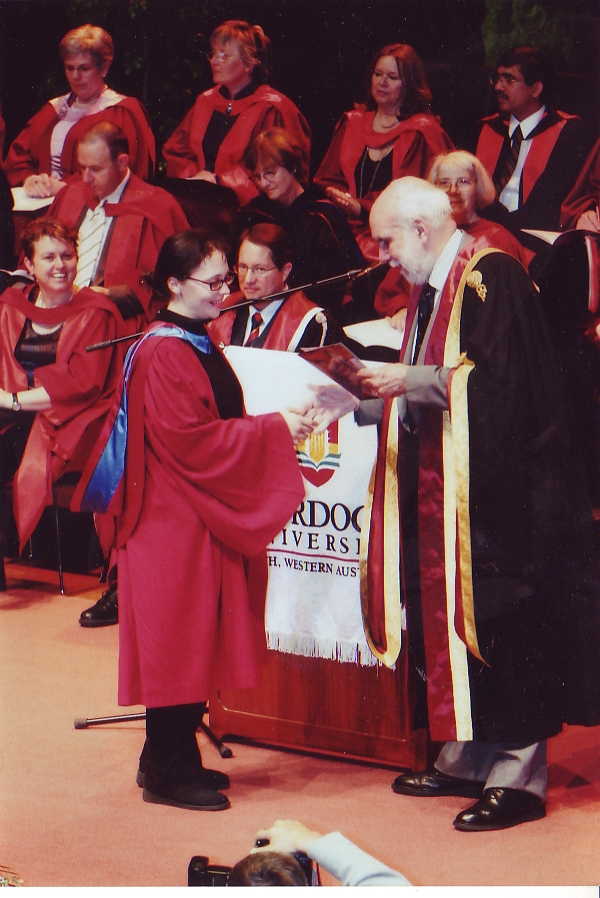
Boundary pusher completes Masters degree after being told uni dream was "pure fantasy"

Milestones are always an excuse to celebrate. They also give you opportunities to reflect and ponder the path that your life has taken and today was no different.


Today was a pretty special day as I graduated with a Masters degree from Monash University. While for most people this is a truly acceptable and normal rite of passage, for me going to university was never an option.


Right from my childhood I was told that I would not be going to university and this narrative continued right though high school. It was during my final year of school that I made the mistake of admitting to the “guidance councillor” that I wanted to attend university because I wanted to broadening my horizons and learn about what was happening around me.

Her response to this was to tell me that “You’ll never get into university” and such a dream was pure fantasy. But something inside of me told me that this was an invitation to walk away and do exactly the opposite.


It was like she had said NO to the wrong person because from that moment I knew that I was going work towards the opportunity to learn about politics, literature and everything about the world that I lived in. 

But as luck would have it, the educational establishment that I attended felt the need to fiddle with my final year enrolment so that, despite the hard work, it rendered my matriculation null and void.

However, by sheer hard work and tenacity, the university entrance requirements were soon met (via secretarial and art school) but when it was time to actually apply I became aware of one final challenge. The Parental Unit would never support this idea.

If they knew, they would have entered into a negative campaign in an attempt to plant the seeds of doubt that could kill any dream to gain an education.

I wasn't going to let this happen.

This meant that my uni application had to be submitted in top secret. The first they heard about it was from the massive yell fest that occurred when the offer of a place arrived.

According to their logic I wouldn’t have been admitted or let alone been able to pass, for the simple reason that disabled people don’t do well at university.

Apparently! 

They felt that my future lay in more vocational pursuits or doing manual labour such as plucking dead chickens or cleaning toilets, which is ironic but we won’t go there.

But luckily once they got used to the idea, they were wonderfully supportive and I couldn't have done it without them.

After attending my graduation this evening, a Michael Jordan quote comes to mind, 'If you accept the expectations of others, especially the negative ones then you will never change the outcome'. Just says it all really!!


I would like to dedicate this blog to my Maman and Papa who, while being the original doubters, gave me the love of learning as well as a passion for ideas and books in the first place. Also I thank them for their support and patience; I couldn't have done it without them.


Monday, May 7, 2012

Delusion of Gender debunks gender brain myth

The Delusion of Gender by Cordelia Fine is the recent offering from my Feminist Book Club.

Cordelia Fine is a Neuroscientist by training and this shows in her methodical analysis of the theories that claim that Men and Women are different because of differences in the brain and genetic makeup.

It is Fine’s razor sharp intellect that makes this book such a challenge to read. My knowledge of science and psychological research is very limited (this is not because of my gender, I assure you) so I found some parts of this book difficult to understand and rearticulate. However some of her common themes and narratives I found especially interesting.

One common theme at the beginning of the book is how context influences the role of women in society and how they are perceived by men. She begins by quoting a Joan Smith who argued that ‘very few women, growing up in England in the late eighteenth century, would have understood the principles of jurisprudence or navigation, but that is solely because they were denied access to them’ (2010, page xvii). So it is not that women are incapable to understand complex legal problems or to navigate difficult paths, it is that the cultural context in which we operate that places boundaries on what is considered acceptable activities and behaviours and therefore  limits female participation in particular activities.  

While I didn’t truly grasp her chapters on why male and female brains are not as different as what you might think, I did grasp what seemed to be 3 major themes: firstly, that the quality of research is not as good as it should be.

Secondly, it seemed that popular scientists often make a quantum leap from the actual scientific evidence to arguing that there is a difference between the brains of women and the brains of men. She does argue that this area of science is still in its infancy and we simply do not know how different the brains of women and men are.

Thirdly, she highlights how the brain isn’t a static organ that doesn’t stay rigidly the same from birth right through to moment of death. She also goes into how the brain as well as our genetics responds to the cultural context and social environment that we live in. The plasticity of the brain and how it changes and responds to the external environment growth is one aspect of neuroscience that has received quite a bit of attention.

It seems that Fine reminds the reader not to simplify a highly complex organ.

Fine points out that ‘with the right social identity for the occasion or the companion, this malleability and sensitivity to the social world helps us to fit ourselves into, as well as better perform, our current social role. No doubt the female self and the male self can be as useful as any other social identity in the right circumstances. But flexible, context-sensitive and useful is not the same as ‘hardwired’ (2010, 13). She shows that while our behaviour is strongly influenced by our context, it is not pre-programmed and installed before birth.

Again and again, Fine gives many examples that show how expectations and social norms influence how well we do in things such as Maths test as well as the choices we make throughout our lives. Her book could influence how we bring up children with disabilities and could empower minority groups. As she says ‘we saw in the previous chapter that social demands of a situation can change how motivated men and women are to perform well. And psychologists are beginning to uncover other ways in which the social context can change, for better or for worse, the minds power and effectiveness. There turns out to be a striking number of ways that being in the ‘wrong’ social group creates a trickier psychological path to navigate’ (2010, 29).  This shows how easy for people to be affected by social norms and kids have to be encouraged to rise above the limitations and expectations placed on them by society.  

In the later part of her book Cordelia Fine writes about how young children seem to self socialise themselves in to the gender roles without much conscious effort from their families and carers. She argues that ‘as we have seen, children are born into a world in which gender is continually emphasised through conventions of dress, language, colour segregation and symbols. Everything around the child indicates that whether one is male or female is of great importance’ (2010, 227). If you remember back to your school playground days, there were so many unspoken rules that the kids made up among themselves and there were many perennial ones surrounding gender rules and behaviour. Even as children we maintain how each of the genders are expected to behave through scrutiny and punishment.  

Even in the twenty first century when people are aware of the damaging results of stereotypes, humans seem to be naturally predisposed to perpetuating the gender roles regardless how much they try not to. She tells a story of a gender studies PhD Candidate who, on finding out that she was expecting a boy, spoke in a “less tender” way to her unborn male foetus. She also tells of a mother who despaired of her young daughter’s love of everything pink despite being raised in a gender natural environment.  
 
This review has only touched the service of Cordelia Fine’s book but I would recommend this book for anyone who wants to learn more about the science behind gender and how complicated gender roles are as well as how blurred the lines are between culture and science.    

Related Posts Plugin for WordPress, Blogger...