If
you spend the majority of your time in Anglo Saxon country you will know that
the food is a tad bland and devoid of any real flavour and so one of the best
things about travelling is trying many new, exciting and wonderfully tasting
dishes.
One
of the stand out trips for me, food wise, was Thailand. Volunteering in a hill
tribe meant that food was super authentic and very different.
We
ate stir-fry pretty much all the time which was prepared in this hut and brought
out on this small round table we ate outside with chickens and dogs running
around our ankles. Likely, I love food and have a fairly robust stomach so I
wasn’t bothered by this in the slightest.
My
most memorable dish was Chang Mai Noodles and this is a bit like the Malaysian
Laksa but hotter and with crispy noodles. The first time we had this dish was
on a local road side joint on the way to Chang Rai and I thought the amount of
chilli would propel us in to space but seriously, it was divine. The second
time around was a lot more bearable chilli-wise but no less wonderful.
Another
great memory from this trip was doing a cooking class. I totally recommend this
for anyone who likes food and travels a bit as you get more of a feel of the
local cuisine and hopefully a few tips on how to cook some dishes at home. Some
classes even take you to the markets to pick up some supplies and this can be
great as markets are always entertaining and full of the unexpected.
Spending
3 interning months in Malaysia was incredible in so many ways but one of best
thing about it was, because of the cost, eating out every day of the week.
If
any of you know some Malaysians you will know that one of the first questions
that they will ask you after saying hello is ‘have you eaten yet?’ I know the
enjoyment of food is pretty universal but the Malaysians take food obsession to
a whole new level. It soon became very normal to start planning what you eat
for breakfast, lunch and dinner from the moment you woke up.
With
Malaysia being home to 3 major ethnic groups, means that the kinds of dishes on
offer is very diverse. You can have curries one night, noodles the next and
Satay or Laksa the next with a Subway (I just had to get some fresh veggies in
at some point) for lunch. Nasi Lemak was always a favourite for breakfast.
Trying
food from street stalls was another great memory. At first I was a little
nervous as I thought I would be getting gastro from eating the food but then I
realised that I should stop being a princess that has given way to 'Namby Pambiness' and that I had nothing to worry about.
Long
after I have returned from Malaysia and Thailand, I’ve always gravitated
towards their cuisine and really attempt to recreate some of the dishes at home
but, in reality, they are a poor imitation.
You
wouldn’t necessarily go to Ghana for the food but spending 5 weeks there meant
that I got to taste a far bit of local food.
Ghana
being on the coast and an exporter of seafood, fish was a major part of any
meal as too was rice which often constituted a third of what was on the plate.
Haggis
Food
in Edinburgh doesn’t always come to mind but I really enjoyed it. The carbs and
processed meat (i.e. sausages and Haggis) was always welcome after a long day
running around sightseeing this wonderful part of the world.
tasted nicer than it looked
Having just spent time in Shanghai and India I got to try many amazing dishes.
Chinese food was a delight, with its noodles and dumplings that has me going back for more than what was good for me. I loved every meal and every dish was amazing. Using chopsticks was a great noverlty as well as ordering multiple dishes and sharing them among you and your friends because, after all, eating is a communal activity.
Nicer than it looks, trust me!!
I wouldn't say the Indian that I eat was a disappointment but it was just different to what I had grown up eating. Because I was in the south, it was vegetarian and a lot of rice. Not that I dislike rice but the amount did seem to be a fast track to type II diabetes. But there were several dishes that we did eat that were amazing and to die for but they were often at our local restaurant (don't think it catered for westerners) rather than at our homestay.
I love food!!! Food is great and obviously each place that you travel to offers something new, different and totally exciting. That's what makes travelling so cool.
I
must admit that I am not rich enough to buy products from high end brand such
as Chanel and Louis Vuitton but having recently spent time in China I have
become interested in their relationship with these luxury brands. Louis Vuitton
has recently become China’s favourite luxury brand and the Chinese are their
top customers.
It
has been especially interesting to see how the Chinese have continued to
purchase high end products despite a global financial crisis and a decline in
the ability of the rest of the world to afford such products. It seems that the
Chinese fascination with these products has kept Louis Vuitton in a job and
will continue to do so in the future.
It
has been said by Bain & Co that the Chinese purchases of luxury brands in
2012 has gone up by 31% (although a HSBC reports claims that it is only 25%) while
globally there has been a 7% growth. CLSA, a large investment bank in Asia,
claims that by 2020 China will be responsible for 44% of the purchases of
luxury goods worldwide. Although it is
important to remember the majority of what is purchased by the Chinese is done
overseas. A HSBC report noted that only 10% of purchases are in mainland China.
As
you can see the figures are astounding and this got me thinking of why the
Chinese are responsible for supporting such brands as Louis Voitton and Chanel
when much of the rest of the world is limiting what they spend on products that
are considered extravagant. I am also interested in the impact that this
increase has on Chinese society.
The
reasons for the growth of China’s interest in anything extravagant and opulent
are many and varied but essentially can be seen as an indicator of their own
success.
The
past 20 years dramatic changes in the Chinese economy. Not only are their
manufacturing sector growing to meet the needs of the world technology and
clothing needs but because of the lack of welfare state in China, they are
required to save for
their own retirement and it is this block of saving is that is funding US debt.
But
times are changing. With the opening up of the Chinese economy and the
transition from a planned economy to a market based one, Chinese people are now
choosing to spend their money on goods that they perceive to raise their status
and give them importance in a society where your place in the social ladder is
of great importance.
While
I think there is no doubt that economic progress and the growing Chinese middle
class are good things, the rise of consumerism without any insight into the
effects of such behaviour is a negative side effect of this development.
The
most obvious side effect it the environmental impact of overconsumption. Luxury
items are by their very nature transitory, they are never in vogue (literally)
for very long. As a result, products are brought and then discarded to make way
for the latest model.
Whether
it is luxury goods or technological goods, this culture of just discarding products
because it is out of fashion or there has been a new model released has a great
environmental impact.
The downsides
of China’s interest in luxury items.
There
are social implications of China’s passion for anything luxurious. In a China.org.cn
article on why Chinese love luxury items, Jiao Haiyang
describes what happens when consumerism comes into conflict with traditional
Chinese values. He notes, ‘If the people of a state become materialistic and especially
worship the luxury goods, it will mislead and distort people's value of the
society, increase the psychological imbalance of low-income groups and affect
the social harmony and stability’.
I never really looked
at the consumption of luxury products from this prospective before but it does
make sense that if a society does become too materialist, what society
values such as community spirit, supporting others (especially those who aren’t
well off or those who could not describe as sophisticated, trendy and come
straight from Paris Fashion Week) and cultivating more than just your physical
appearance.
I
know that blogged about Ross Perlin’s Intern
Nationbefore but after spending weeks interning in Shanghai, I have come
to the conclusion that I am what Ross Perlin would describe an Intern Queen.
My
reason for becoming such is simple; I chose to study things that interested me and not areas that had economic value. Being an Intern Queen maybe is the curse of the Arts Grad.
I
went through university being told that extracurricular activities (a.k.a
internships) were the key to getting a graduate job, especially if you were
doing Arts or wanted to get in to an industry that was particularly tough to
break into.
As
an Intern Queen, I’ve seen all kinds of internships: disasters, structured ones
where you learn a great deal, unstructured internships in distant lands that
are a whirlwind of experiences that challenge you personally and professionally
and, more recently, one that is a combination of most of the above.
I’ve
been stuck in a room on my own in the jungle with a boss whose only method of
communication was Skype messaging, despite being in the next room. Another was
everything that an internship should have been with interesting and challenging
work that gave me an insight in to what I was good at as well as an exposure to
the area that I was studying.
But
from my experience and from reading Ross Perlin’s book, I’m beginning to
understand that internships have value and not all internships have the same
currency in the job market. I am also aware now from reading Intern Nation that internships are also
quite unfair.
But
why do people need to do so many or focus on completing the more prestigious
ones in order to get a foot in the door of paid employment in the knowledge
economy?
Perlin
argues that the reason comes down to ‘“systematic overinvestment” and employers
upping the ante: increasingly it takes a prestigious internship or a string of
[great] internships, to put you over the top’ (2011, 132)
This
means that while doing several internships is a positive thing but don’t be
surprised when employers begin to make it necessary to have done bigger, better
and more prestigious internships to get hired.
The
most obvious factor that makes internships unfair is that in many cases you
either have to pay for the privilege or have to be willing to work for nothing during
your internship. Either way, you have to have the financial backing to be able
to participate. I certainly wouldn't have been able to afford my current internship as an undergraduate and my parents wouldn't have paid for it either.
But
not having participating in internships can have consequences and, as Perlin
argues, ‘Not having access to an
internship can be the kiss of death if you want to move up in the world’.
(2011, 165) It is especially true that not having done an internship can make
getting a job so much harder if you have your eyes on the hard-to-get-into
areas of the job market.
Perlin
quotes, David Graeber who points out ‘It has become a fact of life in the
United States that if you choose a career for any reason other than for the
salary, for the first year or two one will not be paid. Graeber points out that
in many professions – charitable work or literary criticism [even politics,
international relations, events and arts management, broadcasting, journalism, international
aid and development] for instance – “structures of exclusion” have excised for
a long time, “but in recent decades fences have become fortresses”’ (ibid). The
building of a fortress has come about from wealthy interns having the done the
right internships with the right organisations to allow them entry to this
fortress.
But
there is another group that also get easy access and this leads into another
level of inequality.
A
less obvious factor in the inequality among the citizens/“want-to-be citizens”
of Intern Nation is the rise of the what has many names but is essentially is
the same thing; “Brilliant Young Thing”, “Pretty Young Thing” and “Professional
Young Person”.
While
this clip is pure satire and completely over the top, we’ve all seen people
like this (without pettiness maybe) in the paper being celebrated for their for
latest accomplishment, being the public face/voice of “youth” through sitting
on every community, government and private business board available, or
participating in some high achievement programme.
When
it comes to finding a job post graduation, they have collected such an
impressive array of experiences and contacts with which no ordinary person can
compete. As a result, these Pretty Young Things are fast tracked into the internship
programmes that are the red carpet to these hard-to-get-into-professions.
The
very existence of these individuals perpetuates a winner-takes-all mentality and
our society’s obsession with “Personalities”.
It’s
not that these Brilliant Young Things are more qualified than anyone else or
necessarily more capable than others it is just that their contacts and public profile get their
application from the middle of the pile to being read. Either that or they received an
invitation by an employer to apply (along with everyone else) for a programme
knowing full well that they will be successful no matter who else applies. The influence of contacts shows that this
worries Perlin when he writes ‘Nepotism, cronyism and the lack of transparency
remains the order of the day in filling many internship potions, even as people
quietly admit that the situation is out of control’ (2011, 231)
Correct
me if I am wrong here but aren’t the whole point of internships meant to give
people practical experience and an opportunity to transition from education to
work or between sectors?
Now
internships seem to be awarded to those who are already fully prepared to gain work in
the knowledge economy rather than those need the assistance in making the
transition. The current system of
internships, as Perlin quotes ones of his interviewees, ‘enables those who have had some
enabling’. (2011, 102)
In
summing up, Ross Perlin writes in Intern
Nation ‘quietly and not-so quietly this “talent myth” has become an
underlying justification for massive and grown inequality, runaway executive
compensation a winner-takes-all economy and an intense focus on superstars’.
(2011, 233) I would love to say that things may change but I somehow doubt
that they will! Everyone who isn’t from an uber privileged (financially or socially)
background will just have to work smarter and harder to gain a place in the
knowledge economy. Link Perlin, Ross. Intern Nation: How to earn nothing and learn little in the brave new economy. (London and New York: Verso, 2011)
Several months ago there was a programme on
Australia’s ABC Radio National that discussed why we travel and how it changes our
out world-view. This discussion has been
at the back of my mind while I planned and embarked on my latest adventure.
It was cited on this programme that one
third of Australians travelled overseas in 2011 and with so many of us packing
our suitcases and grabbing our passports raises the question of what do we want
from the experience and how does it impacts our lives.
The reasons why people go travelling are
many and varied, including seeking an authentic experience of being a strange
person in a strange land as well as getting that adrenaline rush and feeling of
being alive when you’re slightly in danger.
There is also an element of escapism that
travelling provides - either from a dead end job, unsatisfying relationships or
simply living in a sleepy city where life can go by without you noticing.
Author and writer Kris Olsson comment about
life in Australia being ‘wonderful but too wonderful. You can almost fall
asleep here while life passes you by’.
While we do have our little piece of
paradise, it is good to leave to leave it sometimes and to gain perspective,
not only on our own lives but how good we have it as a nation.
The question was posed by presenter Paul
Barclay to The Griffith Review’s Editor Julianne Schultz, whether the great
movement of people will aid understanding or promoting tensions?
Her answer was along the lines of while
Australians may get a sense of how lucky they are to living in a country where
there is a welfare/heath care system, etc but these realisations have yet to
trickle down to the public debate.
You can see this with the debate around
Refugees and if anyone had been to a developing country, logic would have it
that they could begin to understand why people would want to leave their
poverty stricken and/or war ravaged country for a prosperous nation like
Australia.
But no such luck, not yet anyway.
Paul Barclay went on to discuss the concept
of the “Ugly Australian” who extracts nothing cultural from a trip to Bali or
the beaches of Southern Thailand.
Image: Facebook - Perth WA Memes
Bali and Phuket being the places where
thousands of Australians go every year to do what they’d do at home such as
eat, drink and party but at a fraction of the price. It is there that the
stereotype of the Drunken Australian is probably reinforced.
Image: Facebook - Perth WA Memes
But for the many travellers who visit Bali
might find that they their world-view hasn’t changed much as they have been part
of a similar social scene to back home.
Not to mention that their tastes and
sensibilities have all been catered for by Indonesians.
This is one of the things that always
disturbed me about Perth where many seem blissfully unaware of the outside
world and the current issues as well as how good life is here.
Another thing that disturbed me about Perth
was that how the collective mindset is that somehow it is the epicentre of the
known human cosmos. Maybe this sense of over importance exists because there is
this lack of curiosity about the outside world.
Image: Facebook - Perth WA Memes
But back to travelling, this radio programme also discussed the distinction
between a Traveller and Tourist.
My take on it is that the Traveller is
generally the more independent sort who is out for an adventure of their own
making and openly wants their views challenged and changed.
Nima Markets in Accra Ghana
Curiosity rules and wanting to know how others live is of paramount importance. Choosing to going out of their comfort zone and to be slightly shocked and uncomfortable are other signs of the traveller.
The meat delivery to Nima Markets, Accra Ghana
Central Accra, Ghana
A normal and totally accepted activity in a Thai Hill Tribe Image: Kirsten Donnelly
Volunteer project in among the Hill Tribes, North Thailand Image: Kirsten Donnelly
Image: Kirsten Donnelly
Organising their own trip rather than relying
on a travel agent and/or peer group pressure to tell them where and how to go
is also very important to travellers.
Tourists on the other hand, head overseas
for different reasons. Maybe it’s to escape the mind numbing boredom of a
dead-end job or just a change of routine.
Think packaged tours, cruses, nice hotels, Contiki, etc, etc. But whatever the reason there is an element of searching for the exotic. Like when Alain De Botton writes, 'What we find exotic abroad be what we hunger in vain at home.' (2002,78)
Travelling does broaden the mind and give you a different prospective on people, countries and the stereotypes. But the key seems to be intention and attitude. Travel also gives you the space and time to reflect. What Alain De Button in his book on the Art of Travel is so true when he says, 'Journeys are the midwives of thought. Few places are more conducive to internal conversations than a moving plane, ship or train. There is almost quaint correlation between what is in front of our eyes and the thoughts we are able to have in our heads: large thoughts at times requiring large views, new thoughts new places.' (2002, 56)
Wat Rong Khun Temple, Chang Rai
Whatever the reason, travelling is so rewarding as there is so much to see and do. Travelling is especially cool when you mix it up and combine being a tourist and an independent
traveller. This way you can get the best
of both worlds – eye opening and life affirming experiences, adventure as well as relaxation and recreation.
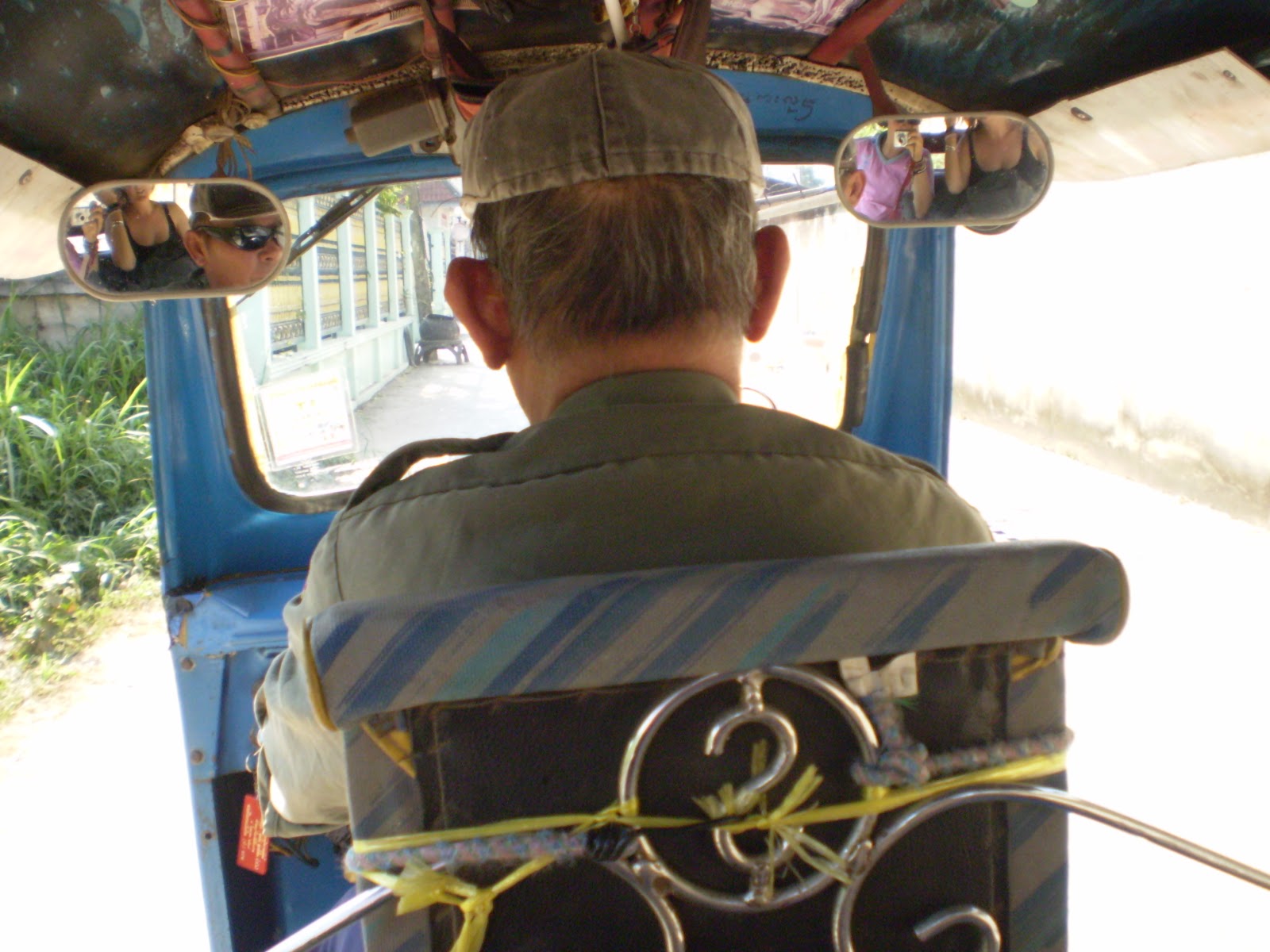
Riding in a Tuk Tuk in Chang Rai, Thailand
Links De Botton, Alain. The Art of Travel (London: Penguin Books, 2002)
 We
ate stir-fry pretty much all the time which was prepared in this hut and brought
out on this small round table we ate outside with chickens and dogs running
around our ankles. Likely, I love food and have a fairly robust stomach so I
wasn’t bothered by this in the slightest.
We
ate stir-fry pretty much all the time which was prepared in this hut and brought
out on this small round table we ate outside with chickens and dogs running
around our ankles. Likely, I love food and have a fairly robust stomach so I
wasn’t bothered by this in the slightest. 
 My
most memorable dish was Chang Mai Noodles and this is a bit like the Malaysian
Laksa but hotter and with crispy noodles. The first time we had this dish was
on a local road side joint on the way to Chang Rai and I thought the amount of
chilli would propel us in to space but seriously, it was divine. The second
time around was a lot more bearable chilli-wise but no less wonderful.
My
most memorable dish was Chang Mai Noodles and this is a bit like the Malaysian
Laksa but hotter and with crispy noodles. The first time we had this dish was
on a local road side joint on the way to Chang Rai and I thought the amount of
chilli would propel us in to space but seriously, it was divine. The second
time around was a lot more bearable chilli-wise but no less wonderful.
 Another
great memory from this trip was doing a cooking class. I totally recommend this
for anyone who likes food and travels a bit as you get more of a feel of the
local cuisine and hopefully a few tips on how to cook some dishes at home. Some
classes even take you to the markets to pick up some supplies and this can be
great as markets are always entertaining and full of the unexpected.
Another
great memory from this trip was doing a cooking class. I totally recommend this
for anyone who likes food and travels a bit as you get more of a feel of the
local cuisine and hopefully a few tips on how to cook some dishes at home. Some
classes even take you to the markets to pick up some supplies and this can be
great as markets are always entertaining and full of the unexpected.


 Trying
food from street stalls was another great memory. At first I was a little
nervous as I thought I would be getting gastro from eating the food but then I
realised that I should stop being a princess that has given way to 'Namby Pambiness' and that I had nothing to worry about.
Trying
food from street stalls was another great memory. At first I was a little
nervous as I thought I would be getting gastro from eating the food but then I
realised that I should stop being a princess that has given way to 'Namby Pambiness' and that I had nothing to worry about.





.jpg)