Thursday, October 18, 2012

The Abbotts wrong on daughter - feminism link


Margie Abbott, the wife of Australia’s Leader of the Opposition came out recently to remind us of Tony’s feminist credentials as the result of having daughters.

Mrs Abbott wanted to remind us that because he has three daughters and her Husband, Australia’s alternative Prime Minister, is a feminist and “gets Women”.

But I am not convinced about Margie’s promotion of Tony as feminist.

Choosing to watch Downton Abbey over the footie does not show that you “get women”

Having three daughters or sisters does not does not make you a feminist.

People operate within a belief system/culture, which in Tony Abbott’s case, is Catholicism and he has continued to show that his patriarchal catholic values influences everything he does.      

But if you don’t follow Australian domestic politics, ultra–conservative Tony Abbott regularly shares his rather traditional worldview regarding women.


For example, in 2010, he said that having a baby is “at the heart of the real life of Australian Women”. So if you don’t have children for whatever reason, you are not a complete individual.

In 2006 he said that he wouldn’t be rushing out to vaccinate his daughters against Cervical Cancer because it “promotes sexual promiscuity”.

He is also on the record in March 2004 as seeing Abortion as the “easy way out”.

2002 saw Tony declare that paid maternity leave will “happen over his dead body”.

He also reminded Australian women that they are the ones doing the ironing.

More recently during the protest against the carbon tax, Mr Abbott had no problems with addressing a crowed that had signs reading “ditch the witch” and referring to Julia Gillard (Australia’s first female Prime Minister) as being a “man’s bitch”.   

It is comments like these that Australian politics does not need. We live in the 21st century where women have contributed to the progress made in this country and will continue to do so in the future.


Feminism is not about hating or belittling men, it is fundamentally about gaining gender equality.

In the past, we have seen women campaign about the right to vote, the right to be financially and socially independent (for example not having to resign once you get married or needing your husband’s permission to get a passport) as well as the right to have control over your body.

Currently, more flexible working conditions, better support from their partners in managing domestic and child rearing responsibilities, gender pay differences and issues surrounding maternity leave and job security are some of the issues facing women.

As you can see, these issues would fundamentally clash with Abbott’s values.

Apart from having control over your body and life, gender equality also means being able to contribute to public life without ridicule.

Maybe the challenge for the feminist movement in the future (among many others) is to eradicate the behaviour see from Tony Abbott.

Until Mr Abbott learns not to make sexist remarks out loud, he will continue to be the target of the “handbag hit squad” and any women who are sick of his misogynistic discourse.

I’ll leave you with the amazing speech given by Australia’s first female PM. It both reminds us how far we’ve come and how far we still have to go.  


Saturday, October 6, 2012

Are Australian youth orchestras failing to develop tomorrow’s audience?


Being a bit of a music fan I often to the many concerts in Perth. If  it is a gig at the Ellington Jazz Club or as part of the Perth Festival, many of the people are my age or younger but when I go to a classical music concert and look out to those enjoying the performance, I can’t help but notice that, collectively, the audience is not looking so young any more.

Along with other forms of art such as ballet, classical music (and to some extent music education) seems to stir up socio-economic connotations that relegate it as bourgeois activity only available to the “elite”. As a result, opportunities for people to be exposed to music and to understand it seem to be limited.

There are few opportunities for people just to have a go.

This is a real shame because it is a genre that has many different styles and I am sure that if there were more opportunities to participate just for the fun of it, people would be more likely to buy tickets to watch the professionals play.

If we make it all about the elite we forget what music is really about.

The benefits of music of every kind have on people and communities are regularly spoken about. It inspires us, it also lifts our spirits and it helps us connect with others. The educational benefits for children of playing musical instruments of every kind and genres are well documented.

Australian Commentator Hugh MacKay’s pointed out that ‘learning to paint or write (in a class that creates its own sense of belonging), putting on plays and musicals, organising festivals, making movies, taking up photography.....singing in choirs, dancing, playing in bands....these are pathways to mental health for people whose daily lives are mostly spent in non-creative pursuit’ (2007:339).     

Since the health and social benefits of music are so obvious then why are opportunities segregated to the “gifted and talented” so soon?

Why the disproportionate focus on developing players rather than developing a wider appreciation of the art form?  
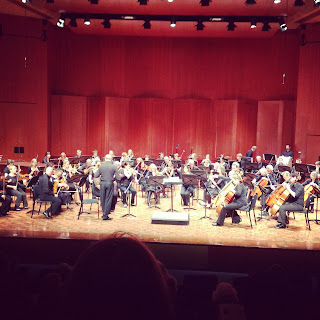
community orchestras, where people play for fun
One study that I looked at argued that, generally, Children exposed to the arts though a good quality art education programme are much more likely to have a lifelong participation in the arts (Kotler and Scheff: 513-529).

Would it be in the best interest of professional orchestras to improve the quality and reach of their education programmes so that that tomorrow’s adults actually want to pay to attend concerts?
  
Since one of my jobs as university student was as an Arts Administration Student with the Youth Orchestra here in Western Australia, I wonder how youth orchestras in Australia are ensuring the sustainability of the art form both in terms of players and of audiences.

For orchestras to be sustainable, they need people to buy tickets to see them perform.

At the moment in Australia the focus seems to be two fold. The focus can be split in to two unequal parts: “Player Development” and, to a lesser extent, “Outreach”/“Community Access”.

It is the overemphasis on the “Player Development” to the detriment of “Audience Development” that causes people to ask if Australian classical music is in crisis.

The problem is that Youth Orchestra Associations as well as many of the State Orchestras disproportionately work on developing the next generation of players rather than people who will come to listen.

My concern is that in 20 or 30 years there will be many orchestras full of gifted and highly trained players but no-one to watch them play because no-one other than these gifted musicians have been exposed to any kind of classical music.      

While there is nothing with elite musical training (because we all appreciate great players, including the synergy that occurs when they come together) but it is a lack of investment in those who will continue to buy tickets in the future that, in my opinion, is one of the biggest problems facing the sector today.

The “outreach” part of the equation usually involve tokenistic performances aimed at pre-schoolers (aptly named “cushion concerts”) or the odd concert in school halls on the fringes of the metropolitan area. Kids are hardly going to hooked for like as a result of 40 minute concert.

But the thing is, while Youth Orchestras and other non-governmental arts organisations are the only ones with the responsibility for this but they are the central part of the solution.

There is an interesting article called “Actively Finding an Audience” Greg Sandow, argues that is defiantly worth a read but I posed him a question on the role of youth orchestras in improving the attendance at classical music concerts.

In his answer he described an interesting paradox where the youth orchestras in the states are thriving but ironically, this doesn't translate into people going to concerts

So, what are we going to do about it?

Australian Chamber Orchestra (ACO) Musical Director and Lead Violin Richard Tognetti once said, in an interview on ABC Radio National’s The Music Show, “that if you look after the milk, the cream will rise to the top”.   

Meaning that if you widen the net of opportunity to a wider range of people, there is no reason gifted and talented will not reach great heights and continue to entertain us with their music.  

It is worth taking a look at some great but under-reported work done in this area. Both the ACO and Britain’s Orchestra of St John Smith Square actively run programmes for with kids who might not be future musicians but just to get them excited about music.

Pity that these sorts of programmes are small in comparison to what happens elsewhere in the world.

Take a look at the youth music programmes in the Berkshire area of England with something for all instruments and abilities. They seem to understand that playing music isn’t just something that should be enjoyed by those who are going to make it their profession but by everyone. 

As a result and as Kotler and Scheff argued, these programmes will have a lasting impact on those who participate in them including greater participation in music later in life.


It will be interesting to see if there will be any classical music when I am 85 years old and if I am the only one in the audience but I am sure it will work itself out, it has to.  Luckily there are lots of other kinds of music to be enjoyed and I look forward to tagging along with my nieces and nephew's children to whatever gigs will be on at the time.   

References


Kotler, Philip and Scheff, Joanne. Standing Room Only: Strategies for Marketing the Performing Arts (Boston: Harvard Business School, 1997) 

MacKay, Hugh. Advance Australia Where? (Sydney: Hachette Australia, 2007) 


Friday, October 5, 2012

It’s all about the coffee

I love a good cup of coffee and especially if it is in a cool little cafe with a good vibe.

Below are some that are new to Perth and some that are old favourites.

Uncle Joe’s Mess has only been open about 3 weeks and is where Zukka was.  This Cafe is tucked away up a corridor behind a shop on King Street.

It has a bit of a war/MASH theme and looks like it should be part of Red Cross field project in Afghanistan.


It has great coffee and lovely food. Defiantly a good place to go!

Uncle Joe's Mess Hall on Urbanspoon

Another newish Cafe that has to be visited is Standing Room Only.

Don’t expect to be able to sit here because it is literally standing room only. Based on the Italian espresso bar, SRO is down Piccadilly Arcade and caters for the true lovers of coffee.

There are no cheap and “starbukky” gimmicks here, just great coffee.
Standing Room Only on Urbanspoon

If you want “starbukky” gimmicks without having to step in side in to a chain of cafes such as the Dome or Gloria Jeans, then try Infusion, down Plaza Arcade.

They are famous for their bags of flavoured coffee and random blends of the day such as Krakatoa East of Java and The Cartel which, from memory, is a blend of Columbian, Brazilian and Guatemalan coffee.

With its friendly barista Terry who is always up for a chat and a laugh, Infusion is great if you want something different.


If you really can’t face another coffee (is that at all possible??) but want to go to a chilled out venue try Cabin Fever, tucked away down Bon Marche Arcade. I tried their Ice Tea and was glad to see that not just a bottle and they made an effort to present it well.

Cabin Fever, like so many cafes have taken on the retro theme. It's retro fitout is is defiantly kitsch but something about the chilled out vibe makes it not too much of a cliché.     


Finally, The Suite in Shenton Park is a cool bar/cafe that also is decked out with that Retro theme. It also has a cool (but small) function room of the same style if you're into that kind of thing. 

It has totally cool menu and great drinks of all kinds and coffee that isn’t bad.  It’s great for coffee moments with dad before work.

Anyway, I hope that this has been helpful and furthered your enjoyment of Coffee.

Thursday, October 4, 2012

Urban food is a reason why city living is so cool


Kuza Urban Japanese Food on Urbanspoon

I don’t know about you but I love food, especially if it is spicy and tastes good.

While I love England, I am not real fan of its traditionally bland food and this is why I love living in large cities where there is lots of different food available.

Today I got to have lunch at Kuza which does Urban Japanese Food in Victoria Park.

With its funky interior, I was keen to see what the food was like and the fact that the other people eating there looked like they were from Japan or the wider Asian region was a good side.


After looking at the menu, I decided on a Ramen Soup (they also do Sashimi and Sushi) and the waitress recommended the Kuza Original with Chashu, Crabmeat and Egg.


I was not disappointed.    

It had a strong seafood flavour that was complimented with plenty of seaweed. At the same time, the fishy flavour wasn’t overpowering and broth wasn’t oily nor was it too heavy.

Their Japanese Green Tea was also great and more than just bland tea bag verity.


So, if you are in Vic Park, drop into this great place and enjoy the great food.

Monday, October 1, 2012

Exploring the Hood


Despite moving in to my apartment several months ago, I haven’t really had the time to explore what my neighbourhood had to offer and now I am on holiday I have the time to explore the area.

My not so new neighbourhood is commonly associated with car yards, funeral parlours and little weatherboard houses, not to mention being a culturally diverse area.


Apart from the cute but plain little houses (although, the area has gone through a long period of gentrification where some more up market places have gone up) that are everywhere, being an inner city suburb it is full of places to entertain and to hang out, even if they are cheap and cheerful.


Many of the places are along the main drag which is quite spread out but thanks to the many buses that go along this bit of highway, it doesn't take long to get around.

One of my favourite places is The Imp and this cool little cafe is always packed. What is so great is this place is the coffee and the very decadent deserts.  The rest of food is ok but the vibe makes up for it.


Another cafe that is worth visiting is Cafe Gelato. This place doubles up as a photo processing shop which sounds a little cheesy but with its cool décor it does have a funky and relaxed feeling about it. The coffee is average (maybe I am just getting picky in my old age) but the Italian Ice cream is amazing.


Being close to Curtin University who attracts lots of students in the Asian Region, there are lots of places to eat and grocery shops that reflect the diversity of cuisine in that region. Thai, Japanese, Chinese, Korean, and Nepalese - it is all there.


Of course being Australia, there is also a heavy Italian influence as well as many pubs.   Cafe Zucchero is another venue that is always packed on the weekend and has a great food menu but the coffee is ok. This cafe is totally worth a visit with friends on any fine weekend.

I am loving living here and look forward to exploring the many other places that are here.  
    

Saturday, September 15, 2012

Parking Tax protest shows how good we have it

Recently, the WA Branch of the Australian Nursing Federation felt that it was necessary to start protesting about the rise of parking costs in many of Perth’s hospitals and this got me thinking about our health system and standard of living.

The ANF and those it represents feel that the increases in what it costs to park your car in a privately run car park at work is completely outrageous and a total abomination.

While it is annoying having to add another mundane item in your weekly budget, I feel that this campaign shows how lucky we are in Western Australia, where the price of parking is all a trade union can campaign about.

In other parts of the world they are not so lucky to have even the most basic equipment, medicine or trained staff. In many places access to cars to drive to work or medicines or employees to sit with patients who are confused and elderly (to ensure their safety) are simply not available.

I am sure that many nurses and doctors from developing countries would love to have nothing to protest about except what it costs to park their car.

In Ghana for example, one story was told of a lady being left to give birth in the open and without professional nursing assistance. It is common in Ghana for there not to be any permanent medical and nursing staff at healthcare posts and limited access to the most basic of medicines and laboratory services.  

The Democratic Republic of Congo is another country where funding the recent civil war has replaced maintaining the health system and ensuring that its citizens are healthy enough to lead productive lives.  

An article in Britain’s Financial Times (September 15, 2009) reports that 2006-2007 alone, children accounted for 47% of all those who died, although they only constitute only 19% of the total population.

I could go on and write about every country who  is unable able, for whatever reason, to provide a functional healthcare system but I am sure you get the picture.  

It’s just a little disappointing that those who take part in the protests (and Australian society in general) don’t take a moment to step back and look at the bigger picture.

In same way that when I overheard a visitor tell a patient in hospital where I work that he thought the WA health system was Third World. I wanted to ask them if they had actually been to any developing country and on what evidence where they basing their comparison.

How could anyone say that a large government owned and operated (for now) hospital in Western Australia is of “third world standards"?

With 900 million people not having enough money to access to clean drinking water, let alone access to basic medical care (J Braithwaite, date unknown) such as GPs and midwives shows how people in the developing world have to struggle to visit a doctor or vaccinate their children.


The price of medication doesn't help either. Many of the medications available to these people are patented by for-profit companies in the West which makes them more expensive and out of reach for most people living under 2.8 million living under two dollars a day and the millions more living just above that.


I think those in Western Australia are incredibly fortunate to be able to access a hospital system where so much is provided for.


For example, three meals a day are guaranteed to be served; there is a ready supply of clean bed linen; rooms get cleaned everyday; there are physios, occupational therapists, social workers all trying to get patents ready to go home.


There are even welfare assistants to help patients and their families access government benefits (unheard of in developing countries) if you need it as well as contact utility companies if you are in hospital for longer than expected and need help to rearrange payment


You want to see a Chaplain for spiritual support? One will come to see you without questions, fees or charges.


Hardly sounds like a third world system to me but one that we have access to. Working in a hospital in a large Australian city after travelling in developing countries, I guess that I am more aware of how lucky we are.

Here in Australia we have such a great healthcare system and while it may not be perfect 100% of the time, we are so lucky that it is so much better than much of the developing world. The proof of standard of the Australian hospital system is this campaign by the Australian Nurses’ Federation against a parking tax and it is a shame that it is not more appreciated.

Links.

Anthony Kwaku Amoah. 16 April 2012. The plight of Ghana’s health posts. http://www.ghanaweb.com/GhanaHomePage/NewsArchive/artikel.php?ID=235997. Accessed 15 September 2012

Professor Jeffrey Braithwaite. Date Unknown. Health Care Systems http://www.7billion.unsw.edu.au/health-systems.html. Accessed 20 September 2012.

Emma Pearson. September 15 2009. Congo’s crippled healthcare. http://www.ft.com/cms/s/0/e376ef0e-a1f3-11de-81a6-00144feabdc0.html#axzz26X0i4ADu. Accessed 15 September 2012.

Friday, September 7, 2012

Should your barista be scared?


Over time, there have been inventions that have led some to argue that these new devices will change the way we have consumed things like movies, music and food.

For example videos were touted by some as the end of the cinema and cassette tapes (later CDs) were said to signal the end of people seeing live music. Even the microwave was promoted as the oven’s replacement.

Although as time has gone on we have seen that while all these items have not replaced the movie cinema, the live performance venue or the conventional oven but merely complimented the way we view films, listen to music and how we cook our meals.

What has this got to do with coffee?

With the rise of the home espresso machine see the end of the cafe and the barista who is skilled at pulling the perfect espresso shot that so many of us enjoy every day?

No, I don’t think so!!! Like everything else, our love of cafes will not stop because of the improvements in domestic coffee machines.
 
Having recently been given a wonderful Lavazza Modo Mido I have been thinking a little about how this lovely gift could affect my coffee consumption.

But I will always have a soft spot for my Bodum French Press as it has served me well over the years not to mention that it is easy enough to use at 5 am.  

However, I love my new Coffee machine with its retro style and lime green exterior. It also gives a great little espresso thanks to the easy to use pods. This swanky Lavazza (favourite coffee) machine and its little pods are actually not too bad and better than others on the market.

These pods are the new kids on the block; it is espresso coffee made easy.

This pod idea was made famous by George Cloony and the Nespresso Machine.  However, I fail to understand why people seem so excited by this product especially when it is average at best.


In Perth, a bag of Nespresso pods has become the “must have” accessory item. But for all the hard core coffee fans there is nothing that will get the eyes rolling more than a West Australian carrying a bag of Nespresso Pods like they are the epitome of coolness.       

Some might consider it cheating (in many ways it is) and for this reason that all the true baristas shouldn’t not be scared because while these pod things produce a visually great coffee nothing can replicate human skill.

While it is great that good coffee has been more accessible to domestic coffee drinkers, I don’t think drinking coffee at a cafe with your mates and dates will stop being popular.  

It's ok Mr Barista, we still love your work 


Wednesday, August 8, 2012

What do EU institutions want from interest groups?


Individuals lobbying their leaders have always been part of the political process and the European Union is no different. There are several reasons why the EU is reliant on interest groups such as access to expertise and legitimacy. 

Lobbying has always been part of public life and the European Union has been no exception. All parties are pursuing their agenda through influencing the EU’s legislative progress as well as initiating legal action (Coen and Richardson, 2009). Most EU officials do accommodate lobby groups and see them as an effective part of the policy process.  Since carrying out research is expensive and the EU not always in a position to pay for this, access to technical information via interests groups is one solution to this problem. 

As Watson and Skacleton argue ‘organised interest provide a wealth of information to EU policymakers and contribute a diverse range of views a legislative process that, on paper, features only the formal EU institutions’ (2008, p. 93). The increasing range of EU policies has meant that it attracts an increasing number of Interest and business groups (that represent a diverse range of views and opinions) and by including them in the policy process then the EU benefits by gaining more legitimacy.

This key to understanding why the EU allows interest groups to lobby officials is that they are two interdependent entities (Bouwen, 2002). In reality, the interest and business groups have what the EU needs (information) and in return, these groups are able to push their agenda. The groups get access to the EU and, in return, the EU gets legitimacy and expert knowledge (Hix, 1999). 

As Rainer Eising argues, ‘interest groups have a particularly important role in connecting European-level institutions to the citizens of the European Union’ (2006, p. 203).   

Legitimacy is an important factor in why the EU allows interest groups. Without expert knowledge and good quality research, the EU does not have the authority to govern.

List of References 

Bouwen, P (2002) Corporate Lobbying in the European Union: The Logic of Access. Journal of European Public Policy, 9, number 3: 365-90.


Coen, D and Richardson, J (2009) “Learning to Lobby the European Union: 20 Years of Change” in Coen, D and Richardon, J. (eds) Lobbying the European Union: Institutions, Actors and Issues. (Oxford: Oxford University Press)  

Eising, R “Interest Groups in the European Union” in Cini, M (2007). European Union Politics (2 edition). (Oxford: Oxford University Press).


Hix, S (1999) “Interest Representation” in Hix, S (eds) The Political System of the European Union (Basingstoke: Macmillan)     

Shackelton M and Watson R (2008) “Organized Interests and Lobbying”, in Bomberg E, Peterson J and Stubb A, The European Union: How does it Work?, (Oxford: Oxford University Press) 

Related Posts Plugin for WordPress, Blogger...